
Egyptian loanwords in the Nuba Mountain languages
Colin Fauré
1
Introduction
Egypt’s proximity to Sudan has favored contacts between the two populations
from the beginning of the Pharaonic period. Thus, commercial relations
developed quickly in this area, facilitated by the richness of the Sudanese subsoil
in gold. This ore was of particular importance for the Egyptian powers, who
used it to run their civil and religious administrations, develop infrastructure and
finance their military apparatus. These growing needs led the Egyptian kings to
colonize the southern lands to manage these mineral resources, first during the
Middle Kingdom (c. 2033 – c. 1780 BC), as far as the second cataract, in the
region called Wawat (wȝwȝt), and then during the New Kingdom (c. 1500 – c.
1050 BC), in its entirety from Aswan and the first cataract to Kurgus, between
the 4th and 5th cataracts, in the region called Kush (Kȝš)1. This presence, over
such long periods of time, allowed the Egyptian culture and language to spread
and take root in these territories. However, the furthest border of the Egyptian
territory in Sudan is to be placed in the Kurgus region, as mentioned above,
which is some 900 kilometers away from Kordofan and the Nuba Mountains. In
these conditions, how and why would Egyptian words have become so
integrated into the different languages of the Nuba Mountains?
It should be remembered that throughout the history of ancient Egypt, the
pharaohs made numerous contacts with their more or less distant neighbours,
whether through trade or in a bellicose manner through wars of expansion or
defense.
Thus, among these peoples, we can mention the Libyans in the West, the peoples
of the various Semitic kingdoms of the Near East (Canaanite, Hittite, etc.) and
the Greeks and the Romans, coming from the North, who settled and took
control of the Egyptian territory during later periods. These contacts led to the
1Egyptians designated as Kush what is called Upper Nubia, between the second cataract
and Kurgus. Later on, this denomination was extended to the whole region described
here.
336
Colin Fauré
creation of numerous ways and means of exchange between these different
populations. Whether commercial, demographic or even military, these
relationships led to interactions between populations. To the south of the
Egyptian Empire lies Nubia. The Egyptian influence over the territory can be
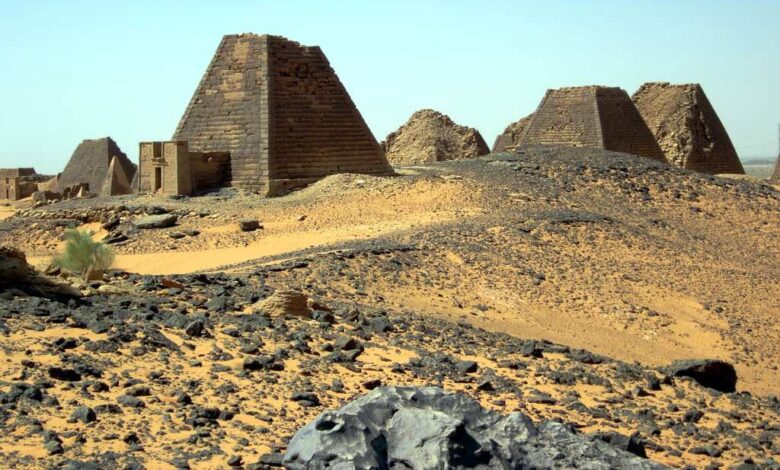
seen first of all in the famous pyramids of Meroe, Nuri and Kurru, the pyramidal
shape of these tombs being borrowed from the tombs of the Egyptians (or, more
precisely, from the tombs of the officials of the Egyptian administration who
were buried in Nubia, like those in Soleb and Tumbus). We can also mention
the representations that can be found outside the pyramids, on some pylons,
where the King is depicted, as the Egyptian kings were, killing their various
enemies and crushing them underfoot. Inside the pyramids, we can also find
representations influenced by Egyptian tomb decorations, such as pictures
showing, in several registers, processions of people presenting food and
treasures to the ruler, or representations of funeral processions showing the king
accompanied by the gods on his way to the afterlife.
Languages do not escape cultural influences, so that we can still find today words
derived or borrowed from Ancient Egyptian, in geographical areas where
Egyptians never travelled, and where the Egyptian language was unknown. In
western Europe, for example, traces of this journey can be found. We can cite
words like paper (papier in French), which comes from Latin papyrus, borrowed
from Greek πɑπμρος, itself inherited from the Egyptian pȝ pr-ʿȝ (pronounced
[pɑpyro] in late Egyptian), meaning ‘the one of Pharaoh’. This expression
reflects the monopolistic nature of papyrus production. Since Egyptian society
was based on strong and plentiful administration, the royal power wanted to
control its supply. Similarly, gum (gomme in French), has followed the same
path, from Latin gummi, coming through Greek koμμι from Egyptian qmj.t
(pronounced [kemi]) ‘gum’.
A land as close to Egypt as Sudan is no exception. There are therefore loanwords
from Egyptian in languages of the Nuba Mountains. We will focus on these
borrowings in Nyimang and Afitti, two closely related Nilo-Saharan languages
from the Nuba Mountains, forming the Nyima group.
2
2.1
The Egyptian loanwords
The Nyimang calendar, a typical example of the course of loans
The first loans we are going to analyze are some months of the Nyimang
calendar. The apparent path of these words through different languages will
make it possible to outline a standard journey in order to better understand the
other borrowings that we will see later.
Egyptian loanwords in the Nuba Mountain languages
337
The first imported month is the first month of the year: ṱɔ̀ṱɔ̀ (in Ama, the main
Nyimang dialect) or ṱòḓôg (in Mandal, the other Nyimang dialect). This first
month comes from the Egyptian word Thot. It is the first month of the Egyptian
year and marks the beginning of the flood of the Nile (called the Akhet season).
It is named after the god Thot who, among his attributions, is the reckoner of
time and seasons (Posener 1963: 301). The Egyptian word Thot was passed into
Coptic: t
hoout (Vycichl 1984: 58). It was borrowed into medieval Christian
Nubian, which uses the first Egyptian form, t
hot
h, and finally was imported into
the Nyimang language. The transformation to ṱɔ̀ṱɔ̀ is quite obvious with the
addition of a final /o/. For ṱòḓôg, the second /t/ devoiced to /d/. The added ending
/g/ is unclear. It might be the trace of a Nubian accusative marker (-ga or -ge).
The second month of the calendar is also imported from Egyptian, but only in
Nyimang Ama: it is called bìbìlá. It comes from the Ptolemaic Egyptian month
Paophi. In classical Ancient Egyptian, it was called pȝ n jpt (‘that of Opet’, the
name of Karnak, formerly Thebes). It is the second month of the Egyptian year,
the second month of the Nile flood period. This month refers to the procession
of the festival of Opet, where the sacred bark of Amun goes up the Nile from
the temple of Karnak to that of Luxor. In the same way as the first month, the
Egyptian word passed into Coptic without major transformation: paope (Vycichl
1984: 161). In Sahidic, with some variations in other dialects, it became paop
hi
(Bohairic), paape, poope (Sahidic variation), pawpi (Bohairic), paapi
(Fayyumic) and was then adopted into Old Nubian as p
haWp
hi (/babi/) (Rilly
2010: 189). Here, the /p/ became regularly /b/ and the final /e/ shifted to /i/. The
last borrowing is thus from Old Nubian into Nyimang, where it became bìbìlá.
There is a vowel-copying in the first syllable from /a/ to /i/ and the unexplained
addition of a final syllable lá. Arabic is close to the Old Nubian pronunciation,
with baba.
The fourth month of the calendar is also imported from Egyptian. Nyimang Ama
kwiʃì is originally borrowed from the Ptolemaic Egyptian month Choiak,
originally kȝ ḥr kȝ (from the name of the bull Apis), the fourth month of the
Egyptian calendar and the last month of the flood period. From Ptolemaic, the
transfer to Old Nubian was through Coptic koiahk (Vycichl 1984: 74), identical
to Ptolemaic. Old Nubian transforms Coptic into khoiak (/guiak/), with the
voicing of the initial /k/ into a /g/ resulting in a change in pronunciation. To
arrive at kwiʃì, the initial /g/ devoices back to a /k/, as in Egyptian and Coptic.
With this devoicing, khoi (/gwi/) then becomes /kwi/. This interpretation is
subject to reservations, particularly regarding the second syllable of the
Nyimang word, which does not seem to be etymologically related to its Egyptian
root. This name can also be found in Aramaic (kyḥk) and in Egyptian Arabic
(kiyahk).
338
Colin Fauré
The Nyimang words bwí (Ama) and bùgè (Mandal) correspond to the month of
Pakhons (pȝ n ḫnsw ‘that of Khons’), the ninth month of the year and the first
month of the harvest period (called Shemu). It refers to the full moon of the
month, associated with the god Khons. The Egyptian word, before reaching
Nyimang, first passed through the Coptic pahons (Vycichl 1984: 167). The /x/
has been transformed into /g/, both being velar sounds. This word is still used
in Dongolawi Nubian to designate the summer season and became fagoon in
Nobiin. From Coptic, pahons was borrowed by Old Nubian to become pahon.
Thus, when it was transferred into Nyimang Mandal, the /a/ was replaced with
a /u/ and the ending on became e. For Ama, Rilly tells us that bwí originally had
a /g/, but it became silent (Rilly 2010: 189). Thus, the Ama form would result
from the loss of /g/ and the addition of the final vowel /i/. This month is also
found in Arabic: bašans.
These different examples show us quite similar paths: a word of Ancient
Egyptian origin passed into the different Coptic dialects. From there it was
borrowed into the Nile Nubian languages and finally settled in the Kordofan
Nubian languages. Despite some slight differences, the following loanwords
have taken this same route.
2.2
Other examples of loans
The first loan is not a month. It is found in the Nyimang and Afitti dialects and
concerns the word for ‘sword’. In Afitti this word is síddì. In Nyimang, it is
ʃibiḓì. They both have an Egyptian root: they come from the Egyptian sfṯ,
bearing several meanings, all related to the field of butchery or slaughtering: ‘to
slaughter or make a sacrifice’ (since the Old Kingdom, between c. 2700 and c.
2200 BC), a ‘butcher’ (since the Middle Kingdom), a ‘sacrifice’ (since the
eighteenth dynasty, between c. 1550 and c. 1300 BC), etc. sfṯ derived to sf.t
which means a ‘knife’, and later came to mean a ‘sword’ around the eighteenth
dynasty. Since the Middle Kingdom, the final /t/ was no longer pronounced in
the Egyptian language. Thus, the pronunciation of the word should sound like
[sɛ:fe], or something close to it, as we can imagine from the Coptic seefe
(Vycichl 1984: 204). From this point on, the word was also borrowed in the
Arabic term sayf ‘sword’. The two loanwords in the Nyima languages show a
rather similar course. From Egyptian, the root passed into the Nile languages
and then into Kordofan Nubian (also called Ajang), and was eventually imported
into Afitti and Nyimang. Thus, Egyptian sf.t became *sibidi in early Nile Nubian
and later siwid in Kenuzi-Dongolawi. The Egyptian /f/ became first /b/, then /w/,
and a final /d/, which was originally a singulative marker in Nile Nubian, was
added. These changes were then imported into Kordofan Nubian and then into
Afitti and Nyimang in two different forms:
Egyptian loanwords in the Nuba Mountain languages
339
• In Afitti, the central /i/ of the original Early Nubian *sibidi fell off and
the resulting cluster bd assimilated to dd, resulting in síddì.
• In Nyimang, the term remained closer to the original Early Nubian
word, ʃibiḓì.
In the two Nyima languages, the word for ‘sword’ is imported, just like in the
other Nubian dialects of Kordofan: sibit (in Dair), siibdɛ (in Kadaro), sibit (in
Ghulfan) or ʃibid (in Dilling). All these words have the same root, from the
Nubian languages of the Nile, into which it came from Egyptian. This is not a
coincidence because the sword was not a common weapon in this region, the
spear being the more ancient and usual weapon. Thus, the weapon was imported
alongside its name.
Since the integration of the loanword into the Nile Nubian languages, the
ending -di appears (*sibidi), notably in Nyimang and Afitti (síddì or ʃibiḓì). This
is the singulative marker. Further details will be added below.
Another word is also affected by this suffix: it is the word for the ‘date palm
tree fruit’. It comes from the Egyptian bnj, which can be found in Coptic
(Vycichl 1984: 29) as beni (Bohairic) or bnne (Sahidic). The Coptic word was
then borrowed into Old Nubian: penti (Browne 1996: 148), pet(t)I (Browne
1996: 150). We observe in these two loanwords, like for ‘sword’, an added
suffix -ti marking the singular. The initial /b/ devoiced into /p/. In pet(t)I, the /n/
in ben assimilated with the second /t/ of pet(t)I.
From this point on, the Old Nubian words spread all around the region, reaching
many Nubian languages.
In Central Sudan, Dongolawi bɛ́nt(i) (Armbuster 1965: 234) has kept the
Egyptian and Coptic initial /b/. The same phenomenon occurs in Nubian, penti
and pet(t)I becoming benti (Hofmann & Vorbichler 1983: 72), while they
become betti (von Massenbach 1962: 177) in Kenuzi (Reinisch 1972: 20). The
Old Nubian apenti form is derived into Nobiin as fenti (Khalil 1996: 114). The
initial /a/ fell off and the remaining initial /p/ (=/b/) became /f/ due to
fricatisation in the initial position, which is systematic in Nobiin.
Regarding the Kordofan languages, several points regarding the date palm fruit
can be underlined.
First, we can observe direct loans from northern languages. The result of these
borrowings is then close to the Egyptian, Coptic or Old Nubian words, despite
some little changes: fɛ́ndɛ (Rilly, p.c.) in Nyimang Ama, fɛnd̪a (Rilly, p.c.) in
Afitti, fɛ́nd̪í (Jakobi ms.) in Dair and hɛ́nt̪í in Dilling (Kauczor 1920: 21, 49) and
Kudur. The -tí ending found in Dilling and Kudur, and the -dɛ, -d̪a, -d̪í ending
340
Colin Fauré
in Nyimang Ama, Afitti and Dair are inherited from the Old Nubian morpheme,
where it marks the singulative. The Kordofan languages kept this addition. In
Dilling, the singulative is completed by an -nd̪u form (rendered hɛntindu; more
details below). This -ti is devoiced to /d/ in Nyimang, Afitti and Dair. This kind
of suffix is regularly found in imported words. As seen earlier, it is found in the
word for ‘sword’ in some Kordofanian languages. These two words, ‘sword’
and ‘date’, are imported from Ancient Egyptian, where the system is based on
the singular-plural pattern. In this case, the noun is unmarked when it represents
a single item and the plural is expressed by a suffix (in this case, the morpheme
.w). Then, when entering the Nile Nubian languages, which use a singulative
and collective marking in their number marking system, it had to be adapted,
adding the singulative -tí marker. This adaptation is not restricted to Egyptian
borrowings but is also found in the translational equivalent for ‘horse’, which is
imported2 from the Meroitic *mre-ke3 (Rilly 2010: 431): mᴐ̀rd̪ù, mard̪ù, mard̪ì
(Nyimang), mᴐrt̪à (Afitti), múrtí (Nobiin), etc. These three words, for ‘sword’,
‘date’ and ‘horse’, are all imported from other languages. Indeed, the date palm
tree is a cultivated product: the fertilisation, pollination and therefore the
reproduction of the species is difficult, requiring human intervention. Thus, the
date palm tree had to be brought in, in some way, to be exploited in Sudan. This
is visible in the Midob language. The word for dried dates, an export product,
is borrowed from Nile Nubian, itself derived from Egyptian: péendí (Rilly 2010:
403). In contrast, the word for fresh dates, less conducive to export, is borrowed
from the Arabic: tùmmùr or tòmmòr. This word could have been borrowed later,
with the arrival of Arabic-speaking populations.
A second suffix is also added in some languages using these northern
borrowings. The suffix -nd̪u (diminutive suffix) or -t̪únd̪u is common in Ajang
languages. Then, the word for ‘date’ becomes ɛ́ɳɛ́ɳt̪ʊ́ɳd̪ʊ́ in Ghulfan-Morung, in
Ghulfan-Kurgul ɛ́nɛ́nt̪u ́nu ́, in Kururu ɛ́nɛ́nù, in Kadaru ɛ́nd̪índ̪ū and ɛnd̪ɛnd̪u, in
Dabatna ɛ́ɳɛ́ɳd̪ʊ́, and in Debri ɛnd̪onu. In some of these dialects, /d̪/ is deleted
after /n/ (Jakobi ms.: 121). Considering that Ghulfan-Morung and Ghulfan
Kurgul add a genitive marker n (Jakobi ms.: 121) between the Egyptian root and
the -t̪únd̪u suffix, the original root in these languages must be rendered as ɛnd̪ɛ
or ɛ́nd̪í, much closer to the Egyptian than expected.
The removal of /d/ after /n/ is applied in different ways depending on the
language. In Ghulfan-Kurgul, it is applied completely, in the entire word, unlike
in Ghulfan-Morung, where the suffix keeps its original form. As in Ghulfan
Morung, Dabatna and Kururu preserve the suffix. In Debri, the root remains
intact, while the /d/ in the -nd̪u suffix is deleted. In two of these languages, we
2Coming from Mediterranean areas for military reasons.
3The latter may already have had this singular marker with the final -ke.
Egyptian loanwords in the Nuba Mountain languages
341
find the suffix -t̪únd̪u. This suffix, like in many African languages, mean ‘the
child’ (Walker 2018: 52, 68), the fruits being referred to as the trees’ children.
Another word may also have come from Ancient Egyptian. It is the word for
‘shield’, dr or dur in Nyimang, ta ̀r in Afitti. It may come from the Egyptian qrʿw
(*kilɑu or *kulɑu). According to Hoch (1994: 298 f.), the Egyptian word might
come from Ugaritic or a related Semitic language. In the Semitic languages, the
word which means ‘shield’ is qil‘a. The later was also used to designate the
shield bearer, along with qalla‘u. One or the other would have been adopted into
the Egyptian language as a result of the conflicts with the Hittite Empire during
the nineteenth dynasty (Erman & Grapow 1971: 59). This term is found in
Hebrew as kela‘ (which means the ‘sling, curtain, interleaving, door, tent, cell,
sail, fishing net, braid’) and in Arabic as kil‘ (which means the ‘sail’). The use
of the term changes, but its meaning remains relatively close to what the shield
meant. We can still find the notion of protection, here visual. The new definitions
have also kept the link with weaving (valid for the description of fabrics), the
first shields being designed with an interlacing of reed mats. Like the sword,
qrʿw has different meanings: it can designate the object, the shield, or the person
who held it, the shield bearer. After Egyptian, the word would pass through
Meroitic and Proto-Nubian *kar (which retains only the first syllable). The initial
/k/ became regularly /t/ in Afitti and less regularly /d/ in Nyimang. In Coptic,
the same phenomenon occurs: the word for ‘shield’ is only composed of the first
syllable of the Egyptian word, qal (Vycichl 1984: 337), the /r/ turning into /l/.
However, it is not known whether this word definitely passed from Egyptian
into Nyimang. It could only be a chance resemblance.
3
Conclusion
We have seen that transfers between Egyptian and Nyimang or Affiti can still
be observed today. These borrowings were made indirectly, through one or more
other languages, notably the Nile languages. If there are so many loans through
Coptic, it is because the former and the latter have the same religion, that is,
Monophysite Christianism. However, the origin of these transfers is rather
unclear. Two hypotheses can be proposed:
• The first would attribute these imports to populations from Kordofan
who, after having been enlisted in the armies of the medieval Nile
Nubian kingdoms, would have returned home and spread certain
words. Thus, examples such as ‘sword’ and ‘shield’ (if the latter does
indeed come from Egyptian) would attest to borrowings from the
military environment. The borrowing of the names for certain months
may also support this hypothesis because of the discipline and the
accuracy the army needed to coordinate itself and act.
342
Colin Fauré
• The other hypothesis proposes, in contrast, the presence of settlements
of the Kingdom of Makuria in Kordofan during the Middle Ages until
the fifteenth or sixteenth century. Thus, the permanent contact between
the two populations would have led to borrowings from the Nile
Nubian languages into the languages of Kordofan, as attested by
numerous Nyimang and Affiti words that have not been cited here
because they do not have Egyptian roots, but are of Nubian origin. The
Kingdom of Makuria is a good candidate for this diffusion because
many of its roots go back to ancient Dongolawi or Old Nubian and are
found in all the languages of Kordofan. This powerful kingdom could
thus have extended southwards, before the dispersion of the Kordofan
populations by the Arab tribes in the seventeenth century.
These two assumptions can work in parallel, one not excluding the other.
However, the lack of archaeological evidence does not allow us to confirm or
deny this hypothesis, as the conflicts undermining the region do not allow the
permanent establishment of archaeological missions on site.
References
Armbuster, Charles Herbert 1965. Dongolese Nubian: A lexicon. Cambridge:
Cambridge University Press.
Browne, Gerald M. 1996. Old Nubian Dictionary. Leuven: Peeters.
Erman, Adolf & Hermann Grapow. 1971. Wörterbuch der Aegyptischen
Sprache V. Berlin: Akademie Verlag.
Hoch, James E. 1994. Semitic words in Egyptian Texts of the New Kingdom
and Third Intermediate Period. Princeton, New Jersey: Princeton
University Press.
Hofmann, Inge & Anton Vorbichler. 1983. Das Nubische Wörterverzeichnis des
Arcangelo Carradori (O.F.M.) aus dem frühen 17. Jahrundert. Vienna:
Afro-Pub.
Jakobi, Angelika. Ms. Kordofan Nubian, a synchronic and diachronic study.
Unpublished manuscript.
Kauczor, Daniel. 1920. Die Bergnubische Sprache. Vienna: Hölder.
Khalil, Mokhtar M. 1996. Wörterbuch der nubischen Sprache (Fadidja/Mahas
Dialekt), edited by Stefan Jakobielski & Piotr O. Scholz. Warsaw:
Zakład Graficzny Uniwersytetu Warszawskiego.
Massenbach, Gertrud von. 1962. Nubische Texte im Dialekt der Kunūzi und der
Dongolawi mit Glossar. Wiesbaden: Steiner.
Posener, Georges. 1963. Philologie et archéologie égyptiennes. Annuaire du
Collège de France 63. 299-305.
Reinisch, Leo. 1972. Die Nuba-Sprache. Wiesbaden: Sändig.
Rilly, Claude. 2010. Le méroïtique et sa famille linguistique. Leuven: Peeters.
Egyptian loanwords in the Nuba Mountain languages
343
Vycichl, Werner. 1984. Dictionnaire étymologique de la langue copte. Leuven:
Peeters.
Walker, Katherine. 2018. Nominal number in Tabaq. In Gertrud Schneider
Blum, Birgit Hellwig & Gerrit J. Dimmendaal (eds.), Nuba Mountain
Language Studies – New Insights, 49‑75. Cologne: Rüdiger Köppe.